Study: Wetland plant competition against invasive cattail
Sweet flag is an emergent wetland plant native to the northern United States and Canada. This perennial plant has bright green blade-shaped leaves that arise directly from the rhizomes and sheath into each other at the base. The foliage has a citrus-like spicy aromatic quality. This plant is protected as a state endangered species in Pennsylvania.
Audio:
Video:
Zoe Hastings
“Pohinahina”
University of Hawai’i at Mānoa
Locale: Hawai’i
Study: Agroforestry design for biocultural restoration in Hawai’i
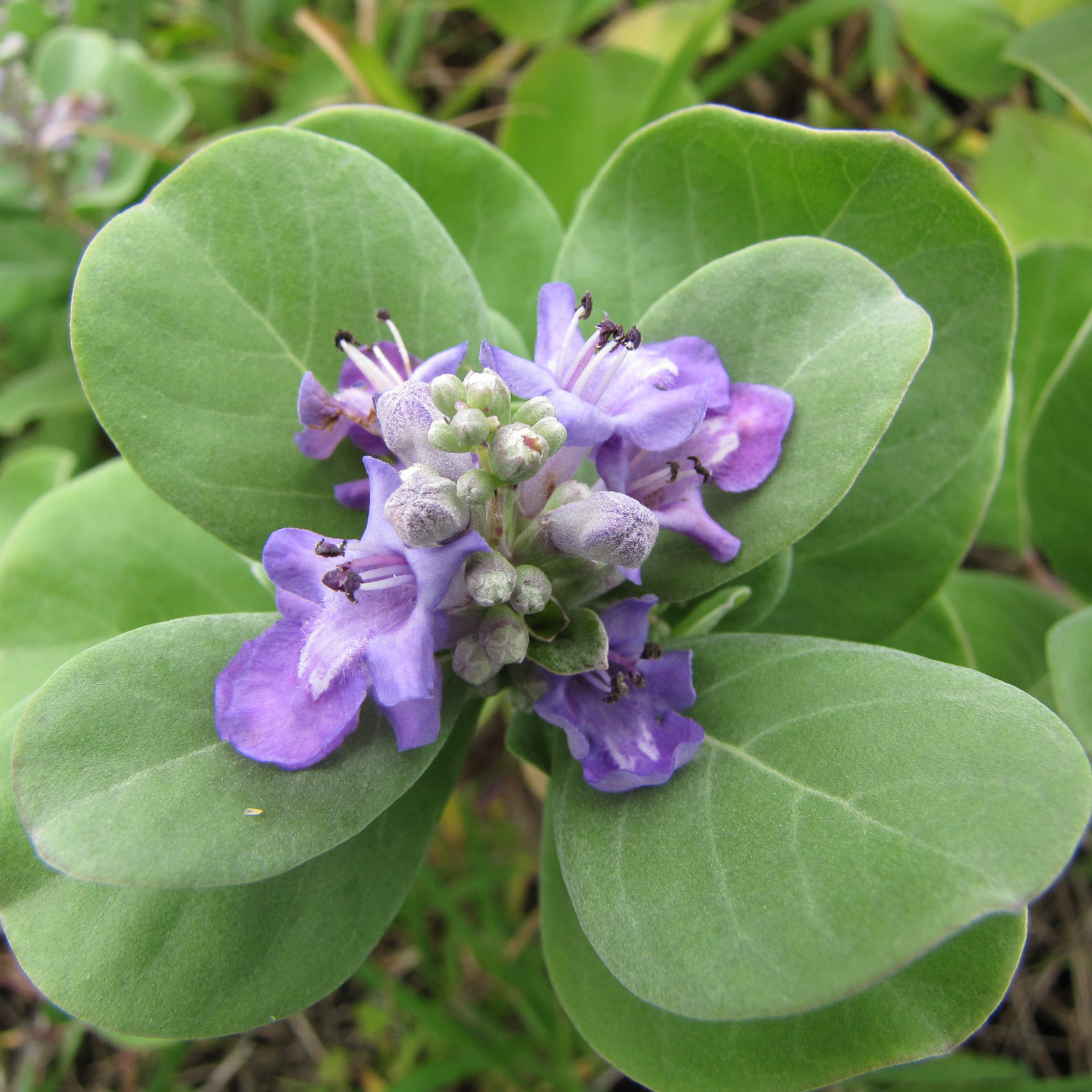
Pohinaina is native to seashores throughout the Pacific. This woody perennial plant typically grows approximately one meter in height. At maturity, Pohinahina produces blue-purple flowers that are borne in clusters and ultimately yield small brown-black fruits. Its leaves are rounded at the tips with green upper surfaces and silver lower surfaces.
Audio:
Video:
Ashley McGuigan
“Musa”
University of Hawai’i at Mānoa
Locale: Hawai’i
Study: Agroforest resilience and contributions to nutritional diversity in Fiji
Musa is one of two or three genera in the family Musaceae. The genus includes flowering plants producing edible bananas and plantains. Around 70 species of Musa are known, with a broad variety of uses.
Audio:
Video:
Rachel Reeb
“Bloodroot”
University of Pittsburgh
Locale: Pennsylvania
Study: Using phenology to improve restoration outcomes in invaded landscapes
Bloodroot is a perennial, herbaceous flowering plant native to eastern North America. They are variable in leaf and flower shape and have in the past been separated out as different subspecies due to these variable shapes. In bloodroot, the juice is red and poisonous
Audio:
Video:
Sarah Skubel
“Rosemary”
Rutgers, The State University of New Jersey
Locale: New Jersey
Study: Using a metabolomic approach to identify novel antibiotic synergies in plants
Rosemary is a woody, perennial herb with fragrant, evergreen, needle-like leaves and white, pink, purple, or blue flowers, native to the Mediterranean region. Rosemary is used as a decorative plant in gardens. The leaves are used to flavor various foods, such as stuffing and roast meats.
Audio:
Video:
Alexa Wagner
“Spicebush”
Case Western Reserve University
Locale: Ohio
Study: Understory response to forest restoration and management
Spicebush is a shrub in the laurel family, native to eastern North America. Within its native range it is a relatively common plant where it grows in the understory in moist, rich woods, especially those with exposed limestone.
Audio:
Video:
Eli Ward
“Garlic mustard”
Yale University
Locale: Connecticut
Study: Impacts of invasive plants on soil nutrient availability in managed forests
Garlic mustard form clumps of round, slightly wrinkled leaves in their first year of growth that smell like garlic when crushed. The plants flower in spring of the next year, producing cross shaped white flowers in dense clusters. When flowering is complete, plants produce upright fruits that release seeds in mid-summer.