Study: Temperate nut trees and their use in temperate agroforestry
Ramps are a North American species of wild onion widespread across eastern Canada and the eastern United States. They are often found in woods with rich soils with moist ground in depressions, and along streamside bluffs.
Audio:
Video:
Veronica Iriart
“Red clover”
University of Pittsburgh
Locale: Pennsylvania
Study: Consequences of herbicide drift on plant mutualisms with pollinators & bacteria
Red clover is a herbaceous species of flowering plant in the bean family Fabaceae, native to Europe, Western Asia, and northwest Africa, but planted and naturalized in many other regions for its use in soil nitrogen fixation.
Audio:
Video:
Sarah Klionsky
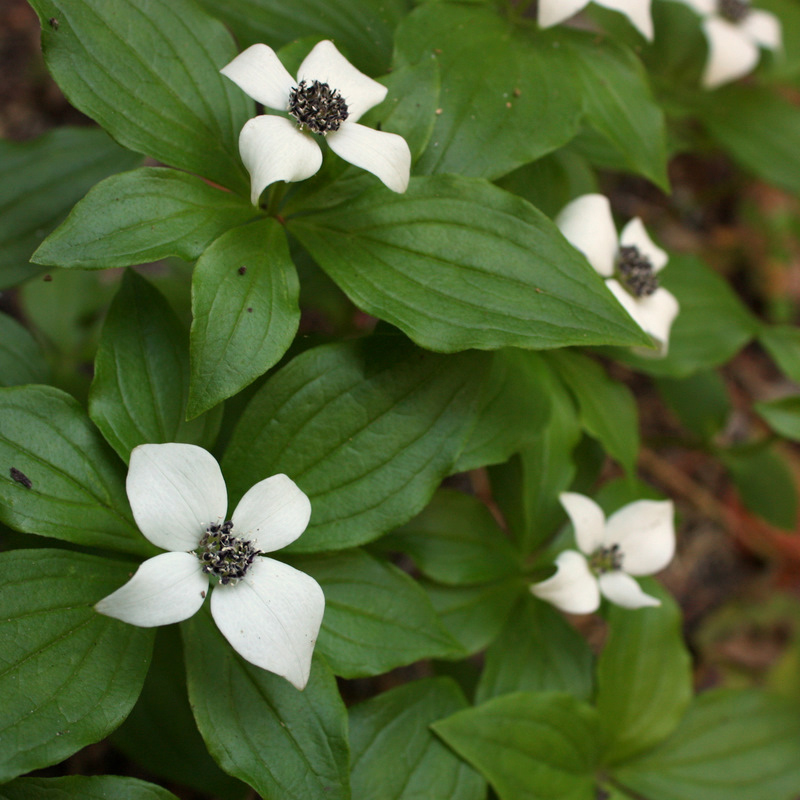
“Bunchberry”
University of Connecticut
Locale: Connecticut
Study: Relationship between wetland nitrogen removal, the plant community & microtopography
Bunchberry is a species of flowering plant in the dogwood family Cornaceae, native to eastern Asia and North America. It is a slow-growing herbaceous perennial generally forming a carpet-like mat. The above-ground shoots rise from slender creeping rhizomes and form colonies under trees.
Audio:
Video:
Rachel Reeb
“Goldenrod”
University of Pittsburgh
Locale: Pennsylvania
Study: Using phenology to improve restoration outcomes in invaded landscapes
Goldenrod is a common name for many species of flowering plants in the sunflower family. Goldenrods can be used as a sustainable method to enrich soil with nitrogen.
Audio:
Video:
Sarah Skubel
“Rose”
Rutgers, The State University of New Jersey
Locale: New Jersey
Study: Natural antimicrobials for the post-COVID era
A rose is a woody perennial flowering plant of the genus Rosa. There are over three hundred species and tens of thousands of cultivars. They form a group of plants that can be erect shrubs, climbing, or trailing, with stems that are often armed with sharp prickles. Their flowers vary in size and shape and are usually large and showy, in colors ranging from white through yellows and reds. Most species are native to Asia, with smaller numbers native to Europe, North America, and northwestern Africa.
Audio:
Video:
Emily Thyroff
“Māmaki”
University of Hawai’i at Mānoa
Locale: Hawai’i
Study: Use of endemic Santalum species in restoring Hawaiian dry forests
Māmaki is a species of flowering plant in the nettle family, Urticaceae, that is endemic to Hawaiʻi. It inhabits coastal mesic, mixed mesic, and wet forests at elevations of 200–6,000 ft. Māmaki is a small tree that reaches a height of 30 ft and a trunk diameter of less than a foot.
Audio:
Video:
Alexa Wagner
“Wild geranium”
Case Western Reserve University
Locale: Ohio
Study: Impacts of forest restoration on shifts in the understory plant demographics
Wild geranium is a perennial herbaceous plant growing up to 2 ft tall, producing upright, usually unbranched stems and flowers in spring to early summer. The leaves have five or seven deeply cut lobes with a petiole arising from the rootstock. The flowers have five rose-purple, pale or violet-purple petals and ten stamens.
Audio:
Video:
Taylor Zallek
“Duckweed”
University of Pittsburgh
Locale: Pennsylvania
Study: How populations of the Lemna minor respond to abandoned mine drainage
Duckweed is a floating freshwater aquatic plant, with one – four leaves each having a single root hanging in the water. As more leaves grow, the plants divide and become separate individuals. Duckweed is used as animal fodder, bioremediator, for wastewater nutrient recovery, and other applications.